
START HERE
City of Merzouga: Your Easy Guide to the Sahara
The first surprise about Merzouga is how quickly the landscape changes. One moment you are passing small houses and date palms. A few minutes later, tall orange dunes rise beside the road. It feels as if the Sahara has suddenly opened a door just for you. This little town in southeastern Morocco is where many travelers begin their first desert adventure, and it is a wonderful place to slow down.
Merzouga is best known for the Erg Chebbi dunes, where you can enjoy a gentle camel trek, watch the sunset, sleep in a desert camp and wake up to a peaceful sunrise. But there is more to do than ride a camel. Local villages, music, markets, stony desert landscapes and the changing light all make a stay here rewarding. This guide will help you choose the experiences that fit your time and travel style, without packing every hour with activities.
For most first-time visitors, two nights around Merzouga are ideal if your itinerary allows it. One night is enough for a sunset and a camp stay, but a second day gives you room for an unhurried breakfast, local discoveries and a little quiet time in the dunes. If you are coming from Marrakech or Fes, remember that the road journey is a major part of your holiday. You can browse Moorish Tour's desert tour options when you are ready to compare routes.

This is a practical guide, not a checklist you must complete. If you prefer a quiet sunrise to a busy excursion, that is a perfectly good way to experience the desert. Moorish Tour can help you choose a private route and desert stay that leaves space for the moments you enjoy most.
LOCATION
Where Is Merzouga and Why Do Travelers Go There?
Merzouga lies in southeastern Morocco, close to the dunes of Erg Chebbi and within the wider province of Errachidia. It is a small settlement, not a big city with shopping malls or busy nightlife. That is part of its charm. You come here for landscapes, hospitality and the chance to wake up somewhere very different from an imperial city.
If you are planning the journey, picture a road trip through changing regions. From Marrakech you may cross the High Atlas Mountains, stop at a historic kasbah and travel through valleys before reaching the dunes. From Fes the common route heads through the Middle Atlas and the green palm groves of the Ziz Valley. Flying to Errachidia can reduce road time if the flight schedule suits your trip, followed by a transfer through Erfoud to Merzouga.
The town, nearby Hassilabied and the camps around the dune edge are separate places, so check the exact location of your accommodation. A camp described as 'Merzouga' may still need a camel or 4x4 transfer from a village meeting point. Ask where the driver will meet you and what time you need to arrive to catch sunset.
| Starting point | Typical route | Travel planning |
|---|---|---|
| Marrakech | High Atlas, kasbah country, southern valleys | A long full-day road journey; often split over 2 days |
| Fes | Middle Atlas, Midelt, Ziz Valley, Erfoud | A long day of travel with scenic stops |
| Errachidia | Ziz Valley and Erfoud toward the dunes | A much shorter road transfer, often around 2 hours depending on stops |
| Erfoud | Paved road south to Merzouga | A short transfer; 4x4 mainly for off-road excursions |
The distances and driving times are only broad planning guides. Rest stops, weather, mountain road conditions and your chosen route can change the journey significantly. Our Errachidia-to-Merzouga tour is useful if you prefer to start closer to the dunes.
THE LANDSCAPE
Erg Chebbi Dunes: The Golden Heart of Merzouga
You do not need to be an expert photographer to enjoy Erg Chebbi. The sand changes color through the day, from soft yellow to deep orange, and even a short walk reveals new shapes around every ridge. Wind redraws the surface overnight. Small footprints and lines in the sand may be gone by morning, which makes each visit feel a little different.
Some dunes reach roughly 150 metres high, although heights vary and not every dune is easy or safe to climb. Take your time if you decide to walk uphill. Fine sand gives way under your shoes, so a gentle climb can feel harder than it looks. A lower viewpoint is often just as beautiful, especially close to sunrise or sunset.
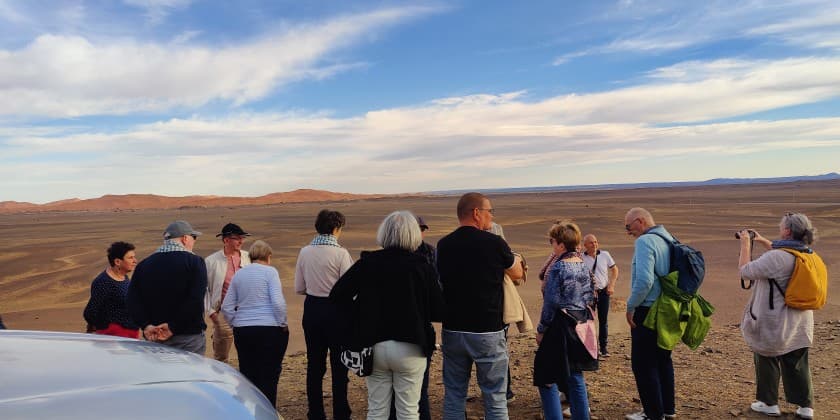
The best part of the dunes is not always the biggest one. It might be the little hollow where the wind goes quiet, or the moment you look back and see the camp far below. If you take pictures, remember to put your camera away for a few minutes. The stillness is a big part of the experience. For more desert travel ideas, see our Erfoud and Sahara excursion guide.
EXPERIENCES
Best Things to Do in Merzouga Without Rushing
There is no single best activity for everyone in Merzouga. Some travelers arrive dreaming of a camel ride. Others want a peaceful camp, an off-road outing or a chance to hear local music. A good plan starts by choosing one main experience and leaving room for the rest. Trying to book every possible activity in one afternoon usually leaves you tired rather than delighted.
| Activity | How it feels | Best for |
|---|---|---|
| Sunset camel trek | Quiet, slow travel across sand | First-time visitors and couples |
| Desert camp night | Dinner, open skies and early sunrise | Travelers who want to stay in the dunes |
| Guided 4x4 outing | Rocky plains, views and local stops | Curious travelers with an extra day |
| Khamlia music visit | Local musical traditions and conversation | Culture and music lovers |
| Dayet Srij visit | A seasonal lake landscape; birds only when conditions allow | Nature lovers and photographers |
| Dune walk | Easy pace with beautiful changing light | Travelers who prefer simple outdoor time |
If you have only one evening, choose a sunset experience and a comfortable place to sleep. With a full extra day, add a village visit or a guided exploration of the stony desert beyond the dunes. Travelers interested in wildlife should know that birds are seasonal and sightings cannot be guaranteed. Our Morocco birdwatching article has ideas for exploring different habitats responsibly.
“One of the nicest things you can do in Merzouga is leave a little time unplanned. The light, the silence and the wide horizon will do the rest.”
CLASSIC SAHARA EXPERIENCE
Camel Trekking in Merzouga: What the Ride Is Really Like
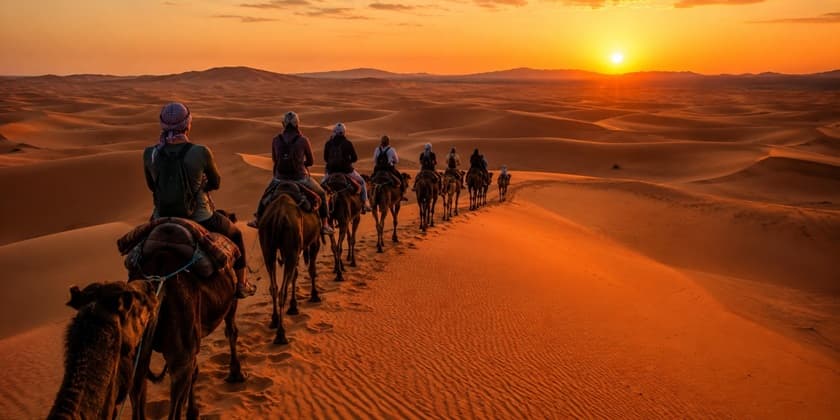
A camel trek often begins in the late afternoon, when the dunes are cooler and the light grows soft. Your guide helps you approach the animal, shows you how to sit and explains what happens when the camel stands up. That first movement can surprise new riders, but the pace usually becomes steady once you are moving across the sand.
Rides vary by operator. Some last less than an hour, while others are longer or include a sunset stop on a dune. Ask about the duration before you book, especially if you are traveling with children or have back, knee or mobility concerns. Wear comfortable trousers and closed or secure shoes, and keep your phone or camera in a safe bag while the camel stands or kneels.
You do not have to ride a camel to enjoy Merzouga. Many camps can arrange an appropriate vehicle transfer instead, depending on their location. Choosing not to ride does not mean missing the desert. If you would like to include this activity, read our camel trekking in the Sahara guide before reserving.
WHERE TO SLEEP
Sleeping in a Merzouga Desert Camp: A Night to Remember
When the sun disappears, the dunes become quieter. You may hear distant voices from another tent or the gentle sound of wind moving across the sand. Dinner often brings people together around a shared table before the evening slows down again. For many guests, the best part of a desert stay is simply stepping outside and looking up at the night sky.
Not every camp is the same. Some have simple shared facilities; others offer larger private tents, attached bathrooms and more comfortable beds. Luxury is not a fixed standard, so always check recent photos and the exact services written into your booking. In particular, ask about hot water, electricity, heating or cooling, the transfer from the road and whether music is planned that evening.

In cooler months, bring a warm layer even if the afternoon was sunny. A desert camp is not a city hotel, and changes in temperature are part of the experience. Travelers choosing a quieter stay can ask about camp size and the distance from other accommodation areas. Compare options in our guide to Merzouga luxury desert camps.
“A beautiful desert night does not need a long schedule. Dinner, a little conversation and a few quiet minutes under the stars are often enough.”
GOLDEN HOURS
Sunset, Sunrise and Stargazing in the Sahara
Sunset is popular for a reason. Shadows stretch over the dunes and the sand seems to turn a deeper orange with every minute. You may see a line of camels on a distant ridge or watch the light fade while sitting quietly with your travel companions. If you prefer fewer people, ask your guide for a viewpoint away from the busiest gathering places.
Sunrise feels different. The air is often cooler, the light is gentle, and the desert wakes up slowly. You do not need to climb the tallest dune; sometimes a ten-minute walk from camp is enough. Bring a light jacket and a small torch for the early start, and keep to a route you can safely follow back.
Stargazing depends on cloud cover, moonlight and nearby artificial light. A clear, dark night may offer wonderful views, but a star-filled sky is not guaranteed on every visit. Avoid shining bright phone lights toward other guests or taking photos that disturb camp staff. The most enjoyable moments often happen when everybody allows the desert to be quiet.
DESERT EXPLORATION
Merzouga 4×4 Tours: Beyond the Sand Dunes
The dunes are only one side of the landscape. A guided 4×4 tour can take you across rocky plains, through small settlements and to viewpoints you would not normally reach on foot. The scenery is more varied than many visitors expect: low hills, dry riverbeds, patches of vegetation and wide spaces where the horizon feels endless.

A good excursion is about understanding the region, not racing across it. Ask for a driver who uses established tracks and respects local communities and fragile desert areas. Driving at high speed can make the outing uncomfortable and increase harm to habitats. If a visit includes a family home or cultural stop, it should be arranged with permission and respect for the host's time and privacy.
The paved road from Erfoud to Merzouga does not require a 4×4, but some off-road routes and camp approaches do. That distinction helps when comparing vehicle packages. You can read more about 4×4 excursions from Erfoud to Merzouga, including what to confirm before a desert drive.
LOCAL CULTURE
Khamlia Village and the Sounds of Gnawa Music
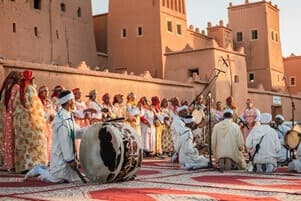
A short journey from Merzouga brings you to Khamlia, a village known for Gnawa musical traditions. You may hear a steady rhythm of hand percussion, singing and metal castanets called qraqeb. The music is connected with a rich history and living community traditions, not simply a performance created for visitors.
A visit can be a lovely part of a longer desert stay when it is arranged respectfully. Ask whether a performance is scheduled and whether a contribution is expected. Take time to listen rather than treating it as a quick photo stop. If you want to photograph or record musicians, request permission first.
Cultural encounters feel better when there is space for conversation. Your guide may be able to explain the music, the area and the ways local people keep these traditions alive. You do not need to understand every word of a song to enjoy its energy and hospitality.
NEARBY DISCOVERIES
Rissani, Erfoud and the Ziz Valley: Easy Stops Near Merzouga
The journey to Merzouga becomes richer when you make time for its neighboring towns. Rissani has a long history as a market and trading center. Depending on the day and opening hours, you may find a lively souk selling fresh food, dates, household goods and many ordinary things local people use. It is a chance to see daily life, not just souvenir shops.
Nearby Erfoud is associated with fossils and date palms. Some visitors enjoy learning how local stone workshops prepare fossil-bearing rock, while others simply stop for a drink before continuing to the dunes. Only buy fossils or other natural items when you are confident they were collected and sold legally; avoid damaging natural sites or protected areas.
The Ziz Valley, often seen on routes from Fes or Errachidia, adds a different color to the journey with long stretches of palm groves surrounded by dry mountain scenery. A viewpoint stop can make the drive feel like part of the holiday rather than something to endure. This is also a useful place to enjoy a relaxed lunch before the final approach to the Sahara.

If you travel with Moorish Tour, tell us whether you prefer a local market visit, fossil history or scenic photography. Not every route needs all three. A short, meaningful stop is usually better than a rushed checklist of towns.
WILDLIFE
Dayet Srij Lake: Flamingos and Birds When Water Is Present
One of the most surprising sights near Merzouga is Dayet Srij, a shallow seasonal lake area. When conditions are wet enough, water can gather against the desert backdrop and attract birds. Greater flamingos and other migratory waterbirds have been observed here in suitable seasons, creating a beautiful contrast between the dunes and the lake.
The lake is seasonal, and it may be dry when you visit. That is important to know before planning a special birdwatching trip. Bird presence changes with rainfall, water levels and migration. Ask locally about recent conditions and never assume that flamingos will be waiting when you arrive.
You can still enjoy the area for its scenery and quiet atmosphere when access is suitable. Bring binoculars if you have them, keep your distance from birds and avoid walking through sensitive wet ground. For more locations and seasonal ideas, visit our bird watching tours guide.
A SHORT VISIT
One Day in Merzouga: A Simple Desert Plan
If you reach Merzouga in the afternoon and must leave the next morning, you can still enjoy the dunes. First, check into your accommodation or meet your camp guide. Take a few minutes to rest, drink water and prepare a small overnight bag. It is easier to enjoy the desert when you are not hurrying from the car directly into an activity.
Afternoon: arrive and settle in Reach the meeting point early enough for your planned camp transfer. Confirm where your larger luggage will stay and whether dinner is included. If you are tired from the drive, consider a short walk or viewpoint instead of adding several activities.
Evening: sunset and camp dinner Choose a camel trek or vehicle transfer, enjoy sunset in the dunes and return for a relaxed meal. Put your camera away for part of the evening. A simple conversation and a warm drink may become the best memory of the night.
Next morning: sunrise and onward journey Wake up early if you enjoy quiet light, then have breakfast before your transfer back to the road. This quick plan works, but it gives little time to explore the wider area. If your schedule allows, staying another night is worth considering. For other short holiday ideas, read our three days in Morocco guide.
THE SWEET SPOT
Two Days in Merzouga: Dunes, Culture and Time to Relax
With two days around Merzouga, you can stop measuring the trip only by activities. Day one is for arriving, seeing the dunes and enjoying a desert evening. Day two opens the door to a small local experience or simply a few hours doing nothing in a beautiful place. That extra time often makes the journey feel much more personal.
Day 1: settle in and meet the dunes Arrive in the afternoon, enjoy a comfortable camp transfer and find a quiet sunset viewpoint. After dinner, listen to music if it is offered, or step away from lights for a little stargazing when conditions allow. Keep the evening relaxed after your road journey.
Day 2: local visits and a slower desert day After breakfast, take a guided village excursion, explore the rocky desert by 4×4 or visit the Dayet Srij area if water and access conditions are suitable. Save some time for tea, photographs and a short walk near the camp. If you enjoy photography, return to the dunes for a different angle at sunset.

You can follow this plan with one or two nights depending on your transport schedule. For families and couples, the key is not a strict timetable. It is choosing a comfortable rhythm that allows everybody to enjoy the scenery.
A SLOWER STAY
Three Days in Merzouga: An Easy Plan for Desert Lovers
A longer Merzouga stay is especially good for travelers who love photography, local culture or quiet landscapes. It also helps if you have come a long way by road and want the desert to feel like a destination, not just a short overnight stop. Three days gives you flexibility when wind or other weather affects outdoor plans.
Day 1: arrive and watch the sunset Keep the first day simple: check in, enjoy a dune walk or camel transfer and settle into your camp. If the sky is clear, enjoy the stars after dinner. You do not need an evening schedule beyond that.
Day 2: discover local life With a local guide, visit Khamlia, explore an appropriate off-road route or stop at the market in Rissani if the timing works. Learn about the area, have a relaxed lunch and return before the hottest part of the afternoon. Use the evening for sunset photographs or an easy walk.
Day 3: sunrise, breakfast and departure Wake up early, watch the light change and enjoy a final breakfast by the dunes. When you leave, plan rest stops on your onward route. Depending on your trip, you may continue through the Dades Valley or return toward Errachidia or Fes.
GETTING HERE
How to Get to Merzouga from Marrakech, Fes and Errachidia
There are several ways to reach Merzouga, but the right choice depends on your starting city and the number of nights available. Travelers sometimes underestimate the drive because a map makes the desert look close. In reality, mountain roads, changing terrain and sightseeing stops mean that travel can fill much of the day. A comfortable road trip gives you time for meals, photos and rest.
From Marrakech, a common route crosses the High Atlas and continues through Ait Ben Haddou, Ouarzazate, the Dades Valley and Todra Gorge. The three-day Marrakech–Merzouga tour is possible, but it includes long travel days and normally one desert camp night. If you can spare four days, you may find the pace more enjoyable. Travelers planning a full country visit can also explore our one-week Morocco itinerary.
From Fes, trips often pass Ifrane, cedar country, Midelt and the Ziz Valley before reaching Erfoud and Merzouga. Our three-day Fes-to-Merzouga itinerary explains this route, while another Fes desert tour via Erfoud gives a different overnight plan. From Errachidia, the final drive is much shorter; check flight schedules before deciding whether this option saves useful travel time.

“For a short holiday, the most relaxing desert tour is usually the one with the least unnecessary backtracking.”
WHEN TO GO
Best Time to Visit Merzouga: Weather by Season
Merzouga is a year-round destination in the sense that the landscape is always there, but the weather changes how you experience it. Spring and autumn are popular because outdoor conditions are often more comfortable. In summer, daytime heat can make long walks unpleasant or unsafe. Winter brings cooler days, but evenings and nights may be cold enough to need several warm layers.
| Season | What to expect | Best advice |
|---|---|---|
| Spring (Mar–May) | Often comfortable, though wind and sand can occur | Bring layers and keep plans flexible |
| Summer (Jun–Aug) | Very high daytime heat | Avoid midday exertion; confirm cooling |
| Autumn (Sep–Nov) | Generally popular for outdoor trips | Book preferred camps in advance |
| Winter (Dec–Feb) | Cooler days and cold nights | Bring warm layers and confirm camp heating |
March and April can sometimes be windy, and desert weather may change quickly. Sand can make driving, photography or camel excursions uncomfortable, so keep room for changes in your plans. In any season, check an up-to-date forecast shortly before you travel rather than relying on an old blog temperature chart.
If you are planning a family trip in July or August, ask about early morning activities, shade, drinking water and the cooling arrangements at your accommodation. If you travel in winter, confirm bedding and heating, especially for a desert tent. Our Morocco general travel guide explains how climates change between the coast, mountains and desert.
PACK SMART
What to Wear and Pack for a Merzouga Desert Trip
Packing for the desert does not mean filling a large suitcase with special equipment. The goal is to feel comfortable while walking, sitting, traveling by vehicle and relaxing after sunset. Loose, breathable clothing works well during warm days. Long sleeves and trousers can also protect your skin from strong sun and windblown sand.
| Item | Why it helps |
|---|---|
| Lightweight long-sleeve top and loose trousers | Sun and wind protection |
| Warm jacket or fleece | Cool evenings and winter desert nights |
| Comfortable closed shoes or secure sandals | Walking on sand and uneven tracks |
| Hat, sunglasses and sunscreen | Strong sunlight and glare |
| Water bottle and personal medicine | Comfort and basic preparedness |
| Small overnight bag and power bank | Camp transfers and charging convenience |
A small day bag is especially helpful if your large suitcase stays at the hotel or vehicle while you travel to camp. Pack a water bottle, your medicine, a power bank, sunglasses and one warm layer. Keep valuables and important documents secure, and do not assume every camp will have convenient charging points beside the bed.
For footwear, choose secure trainers or sturdy sandals that are easy to walk in. Flip-flops may be comfortable around camp but are often awkward on uneven ground. If you are unsure what to wear during the wider Morocco journey, see our Marrakech and Sahara clothing guide for more ideas.
COMFORT & COST
Merzouga Accommodation: Hotels, Camps and Budget Choices
Before you book, think about how you want the evening to feel. Some travelers love sleeping in a traditional camp where dinner and conversation are the main events. Others prefer a hotel close to the dunes with easy road access, a private room and the option to visit the sand without sleeping there. Neither choice is wrong.
| Where to stay | Advantages | Check before booking |
|---|---|---|
| Hotel or guesthouse by the dunes | Easy road access; familiar facilities | Distance to sunset viewpoint and transfer needs |
| Traditional desert camp | A special night in a quieter setting | Shared/private bathroom and bedding |
| Higher-comfort desert camp | Potentially larger tents and more privacy | Actual cooling, heating, meals and transfer |
| Private desert stay | Flexible pace for couples or families | Privacy arrangements and exact services |
Tour prices depend on travel dates, room standard, camp type, transport, meals and activities. Online starting prices can be misleading because they may refer to a shared departure, a different season or a room category that is no longer available. Rather than promising one fixed amount, we recommend requesting a written quote for your actual dates and number of travelers.
Before paying, confirm whether the desert stay includes camel trekking, a 4×4 transfer, dinner, breakfast, local taxes, private bathrooms and cancellation rules. Our luxury camp comparison can help you prepare the right questions. You can also contact Moorish Tour to discuss your preferred comfort level. If you are combining cities and desert, our Morocco Wonders Tour guide has longer route ideas.
FOOD & CULTURE
What to Eat in Merzouga: Simple Meals and Warm Hospitality
Food often becomes part of the memory of a desert trip. After a day outdoors, a warm tagine or a bowl of soup can taste especially good. Local meals may include vegetables, bread, olives, dates and meat or vegetarian dishes cooked slowly with spices. Many camps serve dinner in a shared area, while hotels and restaurants in town offer a wider range of choices.
If you have food allergies or need vegetarian or vegan meals, ask before booking rather than waiting until you arrive at a remote camp. Ingredients and kitchen arrangements vary, and advance notice makes it easier to plan a suitable meal. Drinking water should also be part of your day plan, especially during warm weather.

An offer of tea is often a kind moment, not a reason to rush. Taking time to talk with a local host can help you learn something that no photograph can explain. If you enjoy food as part of travel, our Moroccan food tour guide explores more dishes and traditions across the country.
YOUR TRAVEL STYLE
Is Merzouga Good for Families, Couples and Solo Travelers?
Merzouga can suit many kinds of travelers, but different groups need different plans. Couples often enjoy a private tent, sunset walk and relaxed dinner. Families may want shorter activities, more time to rest and a camp with easy access and practical bathrooms. Solo travelers might prefer a guided excursion or small group experience that makes logistics straightforward.
Traveling with children? Ask about safety around dunes, camel riding suitability, camp steps, sleeping arrangements and temperature control. A child who loves the dunes at sunset may still need a midday rest after a long road journey. It is better to build in breaks than to push through a full schedule.
For anyone traveling alone, arrange your pickup and camp transfer in advance, share basic plans with someone you trust and carry your accommodation's contact details. Merzouga is welcoming, but normal travel precautions still matter. Private tours can provide extra flexibility, while shared outings may be more social. Browse Morocco desert tour packages if you want to compare options.
TRAVEL WELL
Safe and Responsible Travel Tips for the Merzouga Desert
A little preparation makes a big difference here. The desert is beautiful, but strong sun, high temperatures, wind and unfamiliar tracks are real conditions to respect. Travel with enough water, use sun protection, and avoid long walks during the hottest part of the day. If you go beyond the immediate camp area, take a trusted local guide or agree on a clear route and return time.
The landscape also deserves care. Take litter back with you, stay on established tracks during vehicle outings and avoid loud activities near sensitive areas. Do not disturb birds, leave food for wild animals or take plants and stones from protected sites. Cultural visits should be arranged with people who welcome visitors, and photographs should be taken with permission.
Before you book, agree on transport, camp location, meals, group size, inclusions and payment terms. A clear written plan is better than an informal promise. If something feels uncertain, ask another question. Good travel planning should leave you excited about the dunes rather than worried about the details.
TAKE BEAUTIFUL PHOTOS
Merzouga Photography Tips: How to Capture the Desert Light
The dunes are lovely at almost any time, but low sunlight makes their shapes easier to see. Arrive a little before sunrise or sunset so you have time to look for a simple composition. Try including a single camel silhouette, one dune ridge or a small set of footprints rather than filling every frame with too many objects.
A phone camera can make beautiful pictures here. Wipe sand gently from your lens, avoid changing camera lenses in strong wind and carry a protective bag. If you plan to photograph people, ask first. A natural moment with permission is worth far more than an uncomfortable close-up.
Do not walk far into the dunes alone at dawn or after dark just to find a new angle. It is surprisingly easy to lose sight of camp lights behind a ridge. Ask your local guide for safe viewpoints close to the camp or road, and enjoy the experience even if the weather changes your photo plans.
COMMON QUESTIONS
Merzouga FAQs: Clear Answers Before You Go
Still deciding how many days to stay or what kind of camp to book? These short answers cover the questions travelers ask most when planning their first Merzouga visit. The details of any specific tour—especially meals, camp facilities and transfers—should always be confirmed before booking.
1. Where is Merzouga located?
Merzouga is a small settlement in southeastern Morocco beside the Erg Chebbi dunes. It is reached by road from cities such as Errachidia, Fes and Marrakech.
2. Is Merzouga worth visiting?
Yes, if you enjoy desert scenery, sunsets, quiet landscapes and cultural experiences. Allow time for the drive as well as time around the dunes.
3. How many days do you need in Merzouga?
One night allows a brief sunset and camp stay. Two nights are more relaxed and give you time for local villages or a guided 4x4 excursion. More nights suit photographers and slow travel.
4. Can I visit Merzouga without riding a camel?
Yes. Many camps offer vehicle transfers, subject to their location and arrangements. Tell the operator before booking if you prefer not to ride.
5. What is Erg Chebbi?
Erg Chebbi is the group of large sand dunes beside Merzouga, known for their golden color and changing patterns in the light.
6. What is the best time of year for Merzouga?
Spring and autumn often offer more comfortable outdoor weather. Summer days can be extremely hot, while winter nights can be quite cold. Wind may affect activities in any season.
7. Can you see flamingos at Dayet Srij?
Flamingos and other birds may be present when the seasonal lake contains suitable water. Conditions change, and sightings cannot be guaranteed.
8. Is Merzouga safe for families with children?
Many families enjoy visiting with proper planning. Choose age-suitable activities, carry water, avoid peak heat and confirm camp access, bedding and bathroom arrangements.
9. Can you drive from Erfoud to Merzouga without a 4x4?
Yes. The main paved route does not require a 4x4. Certain off-road excursions and camp transfers may need one.
10. What should I wear for a camel ride in Merzouga?
Wear comfortable trousers, breathable clothing and secure shoes. Add a hat, sunglasses and sun protection. Bring a warm layer for winter evenings.
11. Are luxury desert camps air-conditioned?
Facilities vary by camp and tent type. Do not assume heating, cooling, hot water or private bathrooms are available; confirm them directly with the operator.
12. How do I reach Merzouga from Marrakech?
The common road trip crosses the High Atlas and continues through southern Morocco. A three-day return tour is possible but includes long driving days.
13. How do I reach Merzouga from Fes?
Many routes cross the Middle Atlas, travel toward Midelt and the Ziz Valley, then continue through Erfoud. Allow most of a day with stops.
14. What food is served at desert camps?
Menus vary, but common choices include tagine, couscous, soup, vegetables and bread. Mention allergies and dietary needs when arranging the stay.
15. Is Merzouga good for photography?
Yes. Sunrise and sunset often produce beautiful light on dune ridges. A guide can suggest viewpoints, and strong wind may affect camera use.
16. Can Moorish Tour arrange a private Merzouga itinerary?
Yes. Share your travel dates, arrival city, number of travelers and desired activities to discuss a private desert plan and written inclusions.
If you need advice for your particular dates, tell us whether you are arriving from Marrakech, Fes or Errachidia and how many nights you can spend near the dunes. We can help you choose a practical Merzouga desert tour that fits your plans.